
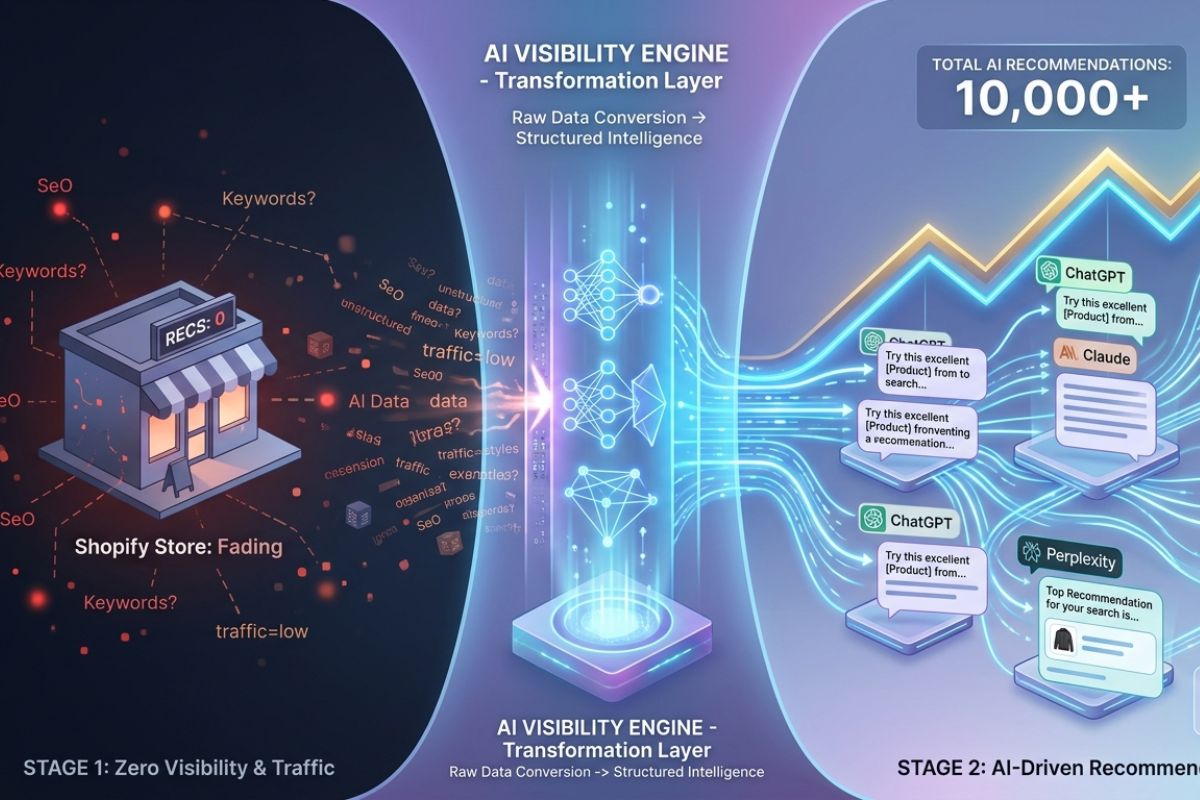
A year ago, this seller was in a familiar position. A Shopify store running decent traffic, some SEO work done, occasional sales from ads, but nothing consistent or scalable. The store was visible in the traditional sense, but not really growing. Then something changed in how customers were discovering products. Instead of starting on Google, they started asking AI tools like ChatGPT, Claude, and Perplexity what to buy. And in that shift, the store started to disappear from where decisions were actually happening.
At first, the seller did not notice. Traffic was still coming in, but conversions were inconsistent. Then they realized something important. Competitors were being mentioned inside AI answers, while their own products were not showing up at all. It was not a traffic problem anymore. It was a visibility problem inside AI systems.
The core issue was not marketing effort. It was structure.
Their product data was scattered across Shopify listings, ad creatives, and SEO pages. Titles were inconsistent, descriptions were written for humans but not structured for machines, and there was no unified signal that explained what the brand actually stood for. From an AI perspective, the store was difficult to interpret. And when AI systems are uncertain, they simply choose something else.
This is where the shift from SEO to AI discoverability became real.
Traditional SEO had helped them rank for a few keywords, but it did not matter inside AI answers. AI systems like ChatGPT and Claude do not operate like search engines. They do not rank pages in order. They generate a single response based on structured understanding, relevance patterns, and trusted information signals. If your brand is not structured in a way that can be consistently understood, it does not get included in the answer at all.
The turning point came when the seller stopped thinking about SEO as the goal and started thinking about AI visibility as the real objective. Instead of optimizing pages, they focused on how their brand and products were represented as structured information that machines could interpret.
This is where Atorse came in.
Atorse sits between a brand and the AI ecosystem, converting raw product and company information into structured intelligence that AI systems can actually use. In this case, the seller used Atorse to unify their product catalog, standardize descriptions, clarify categories, and create a consistent data layer that reflected exactly what they were selling and who it was for.
Instead of fragmented Shopify listings and inconsistent messaging, the store now had a structured identity that AI systems could understand. Products were no longer isolated pages. They became part of a connected intelligence layer that explained relevance, context, and use cases in a machine-readable way.
Once this structured layer was in place, something interesting happened. The store started appearing inside AI-generated recommendations. Not because of ads or backlinks, but because the system could finally understand what the products were, when to recommend them, and who they were for.
Over time, those small inclusions turned into consistent visibility. The store moved from being occasionally mentioned to being repeatedly recommended in relevant AI conversations. That is how it reached 10,000 AI recommendations, not through traditional traffic channels, but through structured discoverability inside AI systems.
You can explore the same approach here: Atorse
What this case really shows is that the game has changed. SEO still matters, but it is no longer enough. AI systems are becoming the primary decision layer for product discovery, and they rely on structured clarity rather than traditional ranking signals. Brands that adapt to this shift are not just getting more visibility, they are becoming default recommendations inside AI answers.
The seller did not change the product. They changed how machines understood it. And that is what created the growth.