
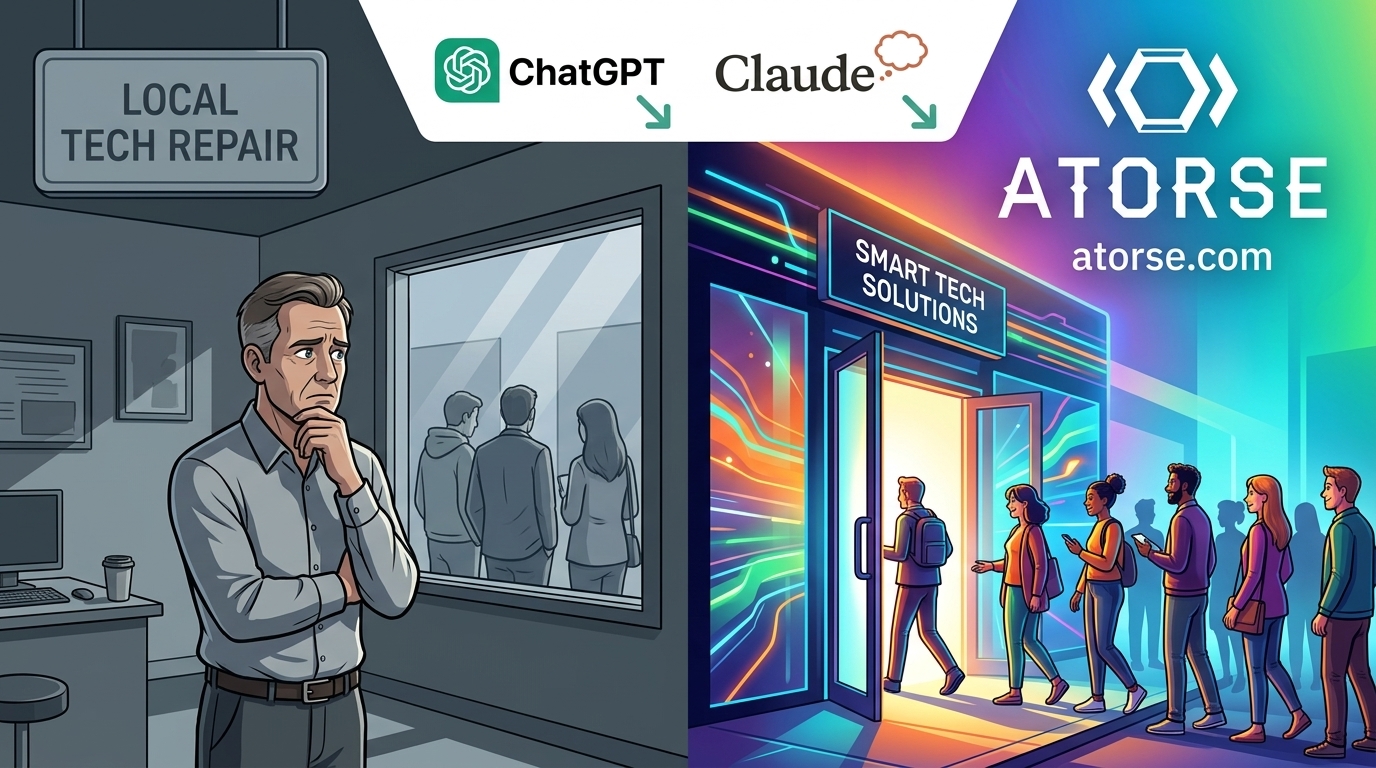
You don’t have visibility into who’s getting recommended by AI.
That’s the problem.
When someone searches on Google, you can see the results. You know which competitors rank above you. You can optimize accordingly. But when someone asks Claude “What’s the best restaurant in my area?” and your competitor gets recommended instead of you, how would you even know?
You wouldn’t. It’s invisible. I realized this when a gym owner reached out asking for advice. “Traffic is steady, but something feels off. I’m not growing.” I asked about their AI discoverability. They looked confused. “What do you mean?”
So I asked ChatGPT for the best gyms in their city. Six recommendations appeared. Their gym wasn’t one of them. I asked again with different phrasing. Still nothing. Then I checked their competitor down the street. Perfect data structure, verified information, clear descriptions. ChatGPT recommended them.
“You’re not losing customers to anything,” I told them. “You’re losing them to invisibility. AI systems literally don’t know about you.” This is happening to thousands of businesses right now. The competitive landscape has shifted, but most business owners haven’t realized it yet. They’re competing in the old arena (Google, Facebook, traditional marketing) while newer players are dominating the new arena (AI discovery).
The scariest part? By the time you realize you’re losing, the gap is already huge.
Here’s how it works: a business optimizes their data for AI. They get mentioned in recommendations. Customers start coming through that channel. Their revenue grows. They reinvest and optimize further. Meanwhile, non-optimized competitors stay invisible. Revenue stays flat. They have no idea why.
Six months later, there’s a massive gap. The AI-optimized business is thriving. The competitors aren’t. And it happened silently, without any traditional “competition”, just algorithmic invisibility. I tested this with different categories. The pattern held everywhere. Hotels with structured data got recommended. Those without didn’t. E-commerce shops with verified product information showed up in AI suggestions. Unoptimized competitors remained invisible. Real estate agents with clean listings got inquiries from Gemini users. Those with outdated information got nothing.
The infrastructure matters that much. Here’s what keeps me concerned: most business owners don’t even have a way to measure this. They can’t see how many times AI systems recommend them. They can’t track which AI systems mention them. They have no dashboard showing “Here’s your AI-sourced revenue.” So they have no idea what they’re missing.
It’s like running ads but never checking the analytics. You’re spending effort (in this case, having a business), but you’re blind to one major channel bringing results or nothing at all.
I built something specifically to address this blindness. It’s called ATORSE. It’s basically a system that makes businesses visible and trackable by AI systems. You get a unique ID. When your business gets recommended, that recommendation is tracked. You see exactly how much revenue is coming from AI discovery.
But before you even get there, you need to know: how much are you currently missing? What’s the gap between your potential and your current AI visibility? That’s why we created a simple calculator. Two minutes. No signup. You find out exactly how much revenue you could be capturing from AI discovery based on your industry, location, and current revenue.
Most people are shocked. But shock is good. It’s the first step to action. Because once you know you’re losing €20,000 per month to invisibility, you start asking how to fix it. And when you fix it, you’re not competing with any specific competitor. You’re claiming revenue that was just sitting there, unclaimed, waiting for someone to make their business discoverable by AI.
The businesses that understand this now will own their markets for years. How much sales from AI?